
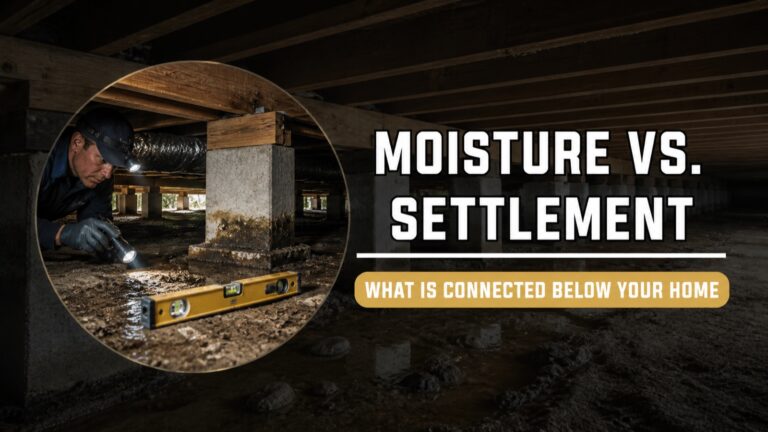
Crawl-space moisture and foundation settlement can appear together, but one does not automatically prove the other. Damp soil may come from drainage, plumbing, groundwater, irrigation, or condensation. Uneven floors may come from framing deterioration, displaced supports, soil movement, or older construction tolerances. The important question is whether the evidence shows a shared cause, separate problems, or a sequence in which moisture contributed to deterioration or soil change.
Signs that point primarily to a moisture problem
- Damp soil or standing water after rain or irrigation
- Staining, efflorescence, or moisture on foundation surfaces
- Wood discoloration, softness, fungal growth, or damaged insulation
- Corroded metal connectors or supports
- Condensation on ducts or pipes
- Persistent odor or high humidity
- Roof or surface water discharging toward the crawl space
The EPA’s moisture-control guidance emphasizes source control. Before selecting a crawl-space product, identify whether water is entering as liquid, moving from the ground, leaking from plumbing, or condensing from humid air.
Signs that point toward settlement or support movement
- A measurable floor-elevation pattern rather than one isolated low spot
- Displaced or rotating posts, piers, beams, or perimeter concrete
- Cracks with movement or displacement
- Gaps at structural connections
- Doors, windows, walls, and floors showing aligned symptoms
- Evidence that previous shims or supports have shifted
- Soil erosion, voids, or loss of bearing beneath supports
Our guide to foundation settlement signs explains why a pattern of symptoms is more useful than judging a single crack.
How moisture and settlement can be connected
Soil moisture changes
Repeated wetting, poor drainage, erosion, or leaking utilities can change support conditions around footings and piers. The effect depends on the soil, grading, drainage path, and foundation configuration. Moisture alone does not establish the amount or direction of structural movement.
Wood deterioration
Long-term moisture can damage sill plates, posts, beams, girders, and joists. A floor may sag because framing has lost section or connections have deteriorated even when the concrete foundation has not settled.
Corrosion and connection loss
Metal connectors, post bases, fasteners, and other components can corrode in persistently damp conditions. The repair must address both the damaged connection and the moisture source.
Erosion or loss of support
Flowing water can carry soil away from a pier, footing, or wall. Voids or softened areas deserve evaluation before supports are adjusted or new concrete is placed.
How an inspection separates the causes
A useful foundation inspection may combine:
- Interior and exterior symptom mapping
- Floor-elevation measurements where appropriate
- Inspection of posts, piers, beams, girders, joists, and perimeter concrete
- Moisture readings and observations
- Review of plumbing, roof discharge, grading, irrigation, and drainage
- Documentation of inaccessible or concealed areas
- Comparison with past photographs or reports when available
A single moisture reading or floor reading should not be used to explain the entire house. Conditions should be interpreted as a system.
Which problem should be corrected first?
Active water sources generally need prompt control so that deterioration or erosion does not continue. Structural conditions also need appropriate support and sequencing. In some cases, temporary stabilization may precede drainage work; in others, a leak or discharge can be corrected before final structural repairs. The order should reflect safety, access, and the diagnosed cause.
Possible work may include drainage improvements, plumbing repair, moisture control, replacement or reinforcement of damaged framing, support correction, house leveling, or foundation repair. Installing a vapor barrier alone will not repair settled supports, and leveling alone will not stop recurring water.
Treat the cause and the structural result
Crawl-space moisture and settlement should be investigated together without assuming they are the same problem. NE Construction & Design evaluates raised foundations, framing, elevations, and drainage conditions for Los Angeles-area homes. If you see water, damaged supports, uneven floors, or recurring cracks, request a consultation.
This article provides general information. Moisture sources, environmental concerns, and structural requirements vary by property.