
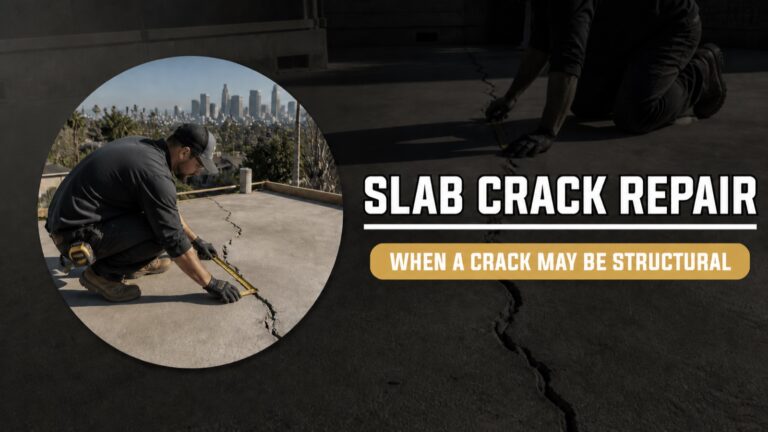
A crack in a concrete slab is a symptom, not a repair specification. Some cracks are related to shrinkage or restrained movement. Others accompany settlement, heaving, loading, corrosion, or loss of support. The correct repair method depends on what the slab does, whether the crack is active, and whether structural capacity, water control, appearance, or surface performance is the objective.
When is a slab crack potentially structural?
No single width makes every crack structural or nonstructural. Conditions that justify a closer evaluation include:
- Vertical displacement from one side of the crack to the other
- A crack that is widening or extending
- Multiple cracks forming a settlement or load pattern
- Cracking near columns, walls, openings, or concentrated loads
- Related movement in walls, doors, finishes, or adjoining slabs
- Water intrusion, soil loss, or voids beneath the slab
- Corrosion staining, delamination, or exposed reinforcement
Surface spalling is different from a through-crack or slab movement, although both can occur together.
Common slab crack repair methods
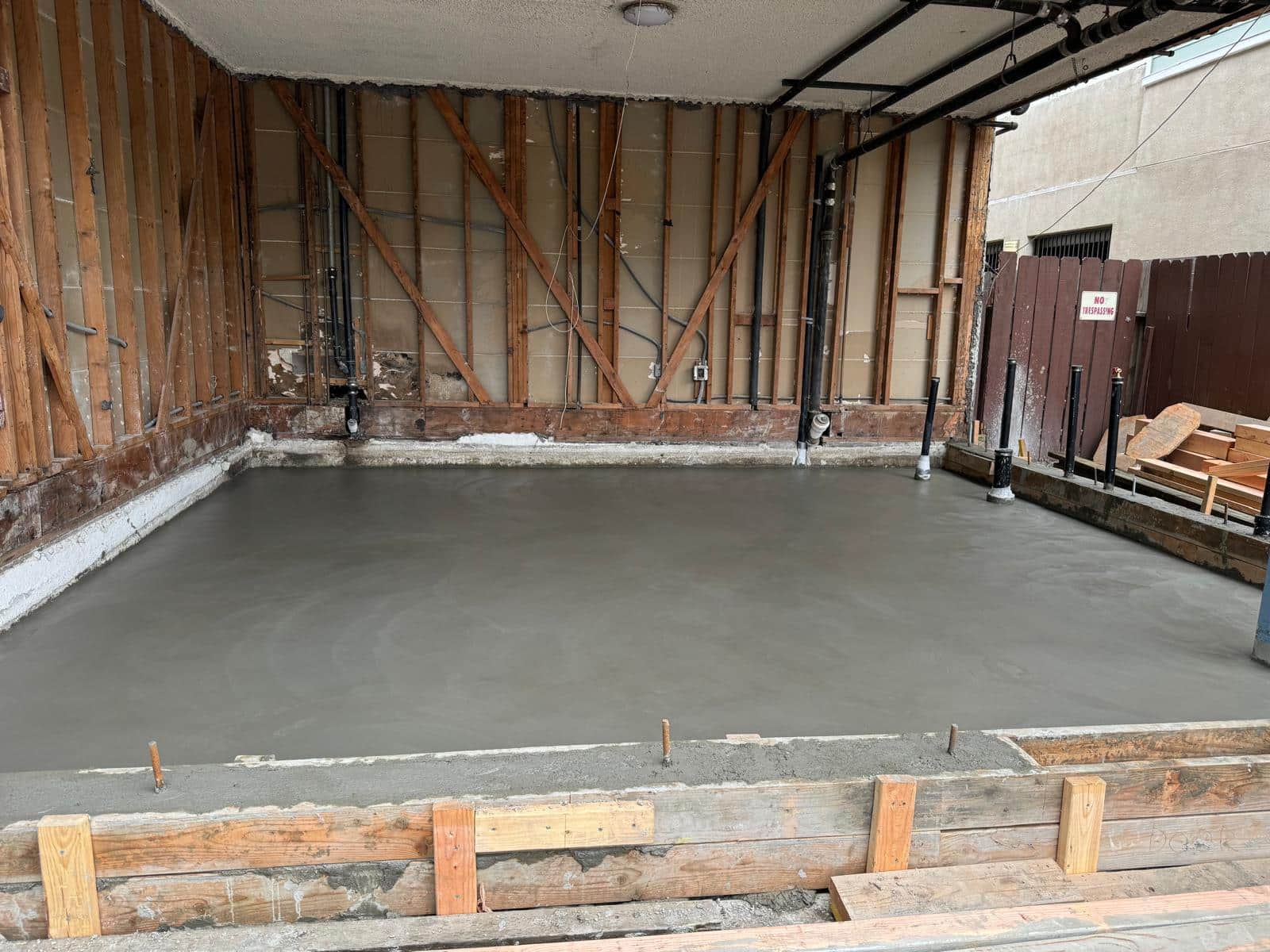
Routing and sealing
The crack is opened or prepared and filled with a compatible sealant. This may help manage water or debris and accommodate limited movement, depending on the material. It does not restore structural continuity by itself.
Epoxy injection
Epoxy can bond suitable, stable cracks and may restore continuity when specified and installed for the actual condition. The crack must be properly prepared, and active movement or unresolved settlement can cause the repair or surrounding concrete to crack again.
Flexible injection or sealant systems
Flexible materials may be selected when water control and movement accommodation are more important than rigid bonding. Product selection depends on moisture, crack behavior, location, and exposure.
Stitching or supplemental reinforcement
Some structural repairs use reinforcement installed across a crack to transfer forces. The design, spacing, embedment, and surrounding concrete condition matter. This is not a universal do-it-yourself detail.
Partial-depth or full-depth removal and replacement
Deteriorated or damaged concrete may need to be removed and replaced. The repair should address unsound material, reinforcement condition, load transfer, joints, curing, and the cause of the original damage. The American Concrete Institute’s repair guidance distinguishes between restoring concrete and strengthening a structural element.
Slab stabilization or leveling
When voids or loss of support are involved, concrete leveling, mudjacking, polyurethane injection, or another stabilization method may be considered for appropriate slabs. These methods address support and elevation; they do not automatically make every crack structurally sound.
Joint conversion or planned movement detail
If movement is expected, a repair may need to function as a joint rather than pretend the concrete will never move. Location, loading, finish requirements, and water exposure influence the detail.
What should be diagnosed before repair?
- Is the crack stable, active, or unknown?
- Is there displacement, curling, settlement, or heaving?
- Does the slab support a structure, equipment, vehicle, or only foot traffic?
- Are voids, erosion, plumbing leaks, or drainage problems present?
- Is reinforcement affected?
- Is water control, appearance, load transfer, or all three the goal?
- Will finishes conceal the repair, and what movement can they tolerate?
Why cosmetic filling often fails
A rigid filler placed in an active crack may split again. A surface patch over displaced concrete can reproduce the same offset. Coatings may hide deterioration without removing unsound material. Durable repair begins by matching the material and detail to the crack’s behavior and the slab’s function.
Permits and professional review
Structural slab work, foundation alterations, significant replacement, and related building work may require plans, permits, and inspections. Requirements depend on scope and jurisdiction. Within Los Angeles, confirm the responsible building department before work begins.
NE Construction & Design provides slab foundation repair, concrete evaluation, and foundation inspection services. If a crack is changing, displaced, leaking, or connected to other movement, request an evaluation before selecting a repair product.
This article is general information and does not replace a property-specific structural evaluation.