
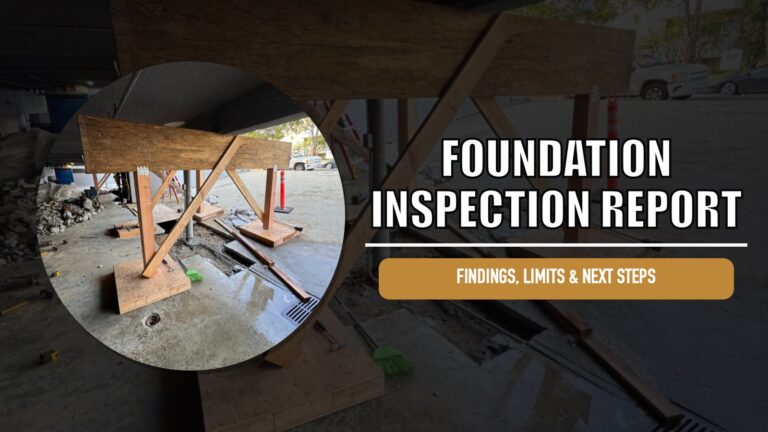
Start with two parts of your foundation inspection report: what the inspector could see and what they recommend you do next. A photo or measurement documents a condition on the day of the visit. The report’s explanation of that evidence helps you decide whether to monitor it, investigate further or ask for a repair scope.
If you’re still deciding what to inspect before buying, use our pre-purchase foundation inspection checklist. This guide picks up after the written findings arrive.
Start with the scope and limitations
Look for the date of the visit, who prepared the report, what they were asked to evaluate and which parts of the house they could reach. A report may cover the visible perimeter and accessible parts of a crawl space. Finished walls, flooring or a blocked crawl-space opening can leave some conditions out of view. If the report says an area was inaccessible, ask whether seeing it could change the recommendation and what access would be needed.
Check whether the scope included measurements, testing or engineering analysis. If you need a licensed engineering opinion, ask who prepared it and verify the individual’s license through the California Board’s license lookup.
Check whether the visit was meant to answer a specific question, such as why a floor feels uneven, or to document visible conditions across the house. Read the exclusions alongside the findings. A report commissioned for one corner of a house may contain useful details about that area while leaving other areas outside its scope. Ask the author to identify any assumptions that matter to the decision you need to make.
Look for a diagram or location key. If a photo simply says “north wall,” ask where the camera was pointing and what feature will let you identify the same spot later. Keep the original report and its attachments. A screenshot of one page can leave out the measurement reference or the access note that explains why the author stopped short of a conclusion.
Separate observations from conclusions
For each finding, match the written description to the location, photo or measurement. “Crack observed at the rear stem wall” is an observation. The cause of the crack and whether it is changing are separate questions. Ask the report author what evidence supports the conclusion and how certain they are. A single visit can establish a baseline. Showing change over time generally takes comparable measurements or reliable earlier records.
If the report includes floor elevations, find the reference point and check where the readings were taken. A reading describes the floor’s position relative to that point. Ask whether floor finishes, framing or other conditions affect how the readings should be interpreted. If the report links uneven floors to moisture, our guide to crawl-space moisture and foundation settlement explains why those findings may need separate investigation.
Use this table to read common report entries
Read each entry together with its location, limitations, and recommendation. The examples below show how to turn a short phrase into a follow-up question. They are hypothetical and do not describe an NE inspection or establish a repair threshold.
| Example wording | What you can take from it | Question to ask next |
|---|---|---|
| “Crack at the rear stem wall” | The report identifies a visible condition and gives you a location to find again. | Does the report record displacement or prior readings? What, if anything, should we monitor? |
| “Rear crawl space inaccessible” | The report cannot describe conditions in that area from this visit. | Would access change a recommendation? Who should arrange it, and what would you inspect there? |
| “Floor low relative to the reference point” | The reading describes the floor relative to a selected point on the date of the visit. | Which points were measured, and are there comparable earlier readings? |
| “Moisture noted near perimeter” | Water or dampness was observed where the report says it was found. | What is known about the source, what remains uncertain, and what needs to be checked first? |
| “Further evaluation recommended” | The author identified a question that remains open. | What question should the next professional answer, and what records should I share? |
Work through three examples
A crack is visible in two photos, but the report says its history is unknown. Check whether the author documented a location, date and any displacement. Ask whether prior photos or repair records would help. If the recommendation is to monitor, agree on where to take the next photos, when to review them, and what would trigger an earlier call. A dated photo gives you a comparison point even if earlier records are unavailable.
One corner reads low, and the report provides a floor-elevation sketch. Find the reference point, then check which rooms the measurements cover. Ask whether the readings were taken across different floor finishes or transitions and whether that affects the interpretation. If someone compares the sketch with an earlier survey, ask whether they used comparable locations, references and methods. Without that context, a difference between two numbers may be difficult to interpret.
The report proposes repair in one area and further evaluation elsewhere. Mark the two recommendations separately. Ask whether the known repair can be scoped now or whether the unresolved condition could change it. Give any contractor the same findings and applicable drawings. If a bid includes work in the unevaluated area, ask the bidder to explain the basis for that scope and to identify assumptions before you compare prices.
Compare reports before treating different wording as a change
If you have a seller’s report, an older repair file and a newer evaluation, put the inspection dates and coverage areas beside one another. Mark where each author had access and what they were asked to assess. Two reports can describe the same home in different ways because one visit addressed a specific concern and the other covered a wider area. Compare the actual observations and recommendations before assuming the findings contradict each other.
For example, an older report may describe visible framing from the front access opening, while a newer one describes moisture at the rear. Those entries concern different locations. Ask the newer author whether the rear was previously accessible, whether the older photos cover it, and whether the difference affects the recommended next step. If there is no comparable evidence, write down that the history is unknown so no one treats it as a measured change.
For a purchase, give the report author the date by which you need a decision and ask what they can clarify within that period. For a home you already own, explain what prompted the evaluation and share any dated changes you noticed. The same observation may lead to different follow-up questions depending on what you’re trying to decide.
Turn each recommendation into a next step
If the report recommends monitoring, ask what to document, when to check it again and what change should prompt an earlier call. Keep dated photos and any measurements in one place so a later visit can compare the same areas.
If the report recommends more evaluation, ask which question remains open and who should answer it. An inaccessible area may need another visit. An unresolved question about structural performance may call for a licensed engineer. If the report flags an urgent safety concern, contact the report author or a qualified professional promptly and follow any access restrictions they recommend.
If the report recommends repair, ask for a written scope that identifies the affected areas, the intended outcome and any exclusions. Find out whether design, permitting or inspections are part of the proposed work or will be handled separately. Our Los Angeles foundation repair permit guide covers questions to raise before work begins.
Make a follow-up checklist for the findings that affect your decision
- Write down the decision. For example, are you trying to understand a purchase risk, plan a repair, or respond to a new change after earlier work?
- Identify each location. Match findings to the report’s labeled photos or sketch. Note where the location or wording needs clarification.
- Separate facts and open questions. Keep observations, measurements, explanations, and any limitations on separate lines so you can see what supports each recommendation.
- Assign the next step. Record who should answer the question, what they need to see, and when you will follow up. For monitoring, ask what would warrant a sooner check.
- Gather the history. Put prior reports, dated photos, available permit records and invoices together. Mark which documents cover the same part of the home.
- Keep the written response. If a conversation clarifies the scope or recommendation, ask for a written summary or updated report so future decisions use the same information.
A simple entry could read: “Rear crawl space was inaccessible on the inspection date. Ask the report author whether access could change the repair recommendation. Share the existing plan and check back once access is confirmed.” Repeat that format only for the findings that affect a decision. Leave the report’s safety or timing instructions visible at the top of your notes.
If more than one professional is involved, give each the same report and clearly identify the question you want answered. You can bring an engineer an unresolved question about structural performance, or bring a contractor a defined scope to price. Our engineer and contractor comparison explains whom to call first. If you already have bids, see our foundation repair estimates guide for comparing what each proposal actually covers.
What to bring to a follow-up conversation
Have the full report, its photos and sketches, and any previous repair records handy. Flag the recommendations that affect what you do next. A good starting question is: “What can I decide from this report today, and what information would change that decision?”
If you have a report for a Los Angeles-area home and want to discuss the next step, contact NE Construction & Design about a foundation inspection. Share the report date, the area of concern and any access limitations so the team can discuss what a follow-up visit could cover.